Hydraulic cylinders for waste collection: why design really matters
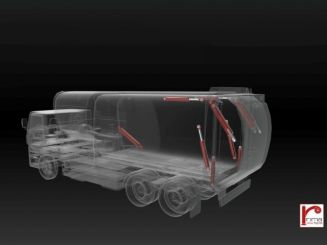
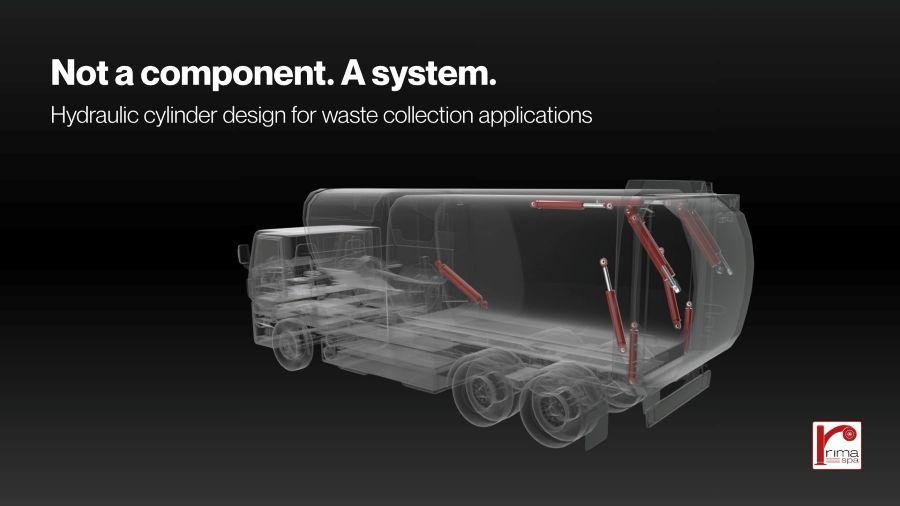
In waste collection vehicles, hydraulic cylinders play a key role in systems such as compactors, lifting mechanisms and handling devices. They operate under demanding conditions, characterised by high loads, continuous duty cycles and complex environments, where variability and dynamic stress are part of everyday operation. In this context, a hydraulic cylinder is not just a component. Its behaviour directly affects the performance and reliability of the entire machine.

Operating conditions as a starting point
Unlike controlled industrial environments, waste collection applications involve highly variable operating conditions. Loads can change significantly from one cycle to another, movements are repetitive and often subject to impact, and external factors such as contamination, moisture and debris must be considered.
For this reason, cylinder design cannot rely on standard configurations. It must be developed based on a clear understanding of real operating conditions.
Cushioning: managing energy at end-of-stroke
One of the most critical aspects in hydraulic cylinder design is end-of-stroke cushioning. When the piston reaches the end of its stroke, the kinetic energy must be dissipated in a controlled way.
Without proper cushioning, repeated impacts generate stress on both the cylinder and the machine structure, leading to vibration, noise and accelerated wear. A well-designed cushioning system allows the piston to decelerate progressively, improving motion stability and contributing to component longevity.
Sealing systems: protection and reliability
Sealing systems are another key element, especially in waste applications where cylinders are exposed to dust, liquids and contaminants. Seals do not simply retain fluid; they are an integral part of the cylinder design.
Material selection, sealing configuration and resistance to demanding duty cycles are essential to ensure consistent performance and operational continuity.
An application-driven design approach
Looking at individual aspects in isolation is not enough. Hydraulic cylinder design requires an integrated approach, where operating conditions, system dynamics and environmental factors are translated into coherent engineering choices.
This means, for example, defining cushioning behaviour based on load and speed, or selecting sealing solutions according to contamination exposure.
This is the approach increasingly adopted by specialised manufacturers. At RIMA, for instance, cylinder design starts from the analysis of real operating conditions and machine interaction, translating parameters such as loads, duty cycles and environmental exposure into reliable, application-specific solutions.
Beyond the component: part of a system
In waste collection machinery, hydraulic cylinders never operate in isolation. Their performance is closely linked to the behaviour of the entire machine.
For this reason, an effective design approach must consider the cylinder as part of a broader system, where each component contributes to overall performance.
Conclusion
In waste collection applications, where reliability and uptime are critical, hydraulic cylinder design plays a central role. From cushioning behaviour to sealing systems and operating condition analysis, every design choice directly impacts machine performance.
Understanding these aspects means developing solutions that are truly aligned with real applications, ensuring efficiency and durability over time.
Explore hydraulic cylinder design in detail
Learn how operating conditions, cushioning and sealing systems influence performance in real applications.
👉 Download the technical whitepaper

FOTOALBUM
NEWS