The new Rimini purification plant
The high-tech giant protecting the sea at Rimini.
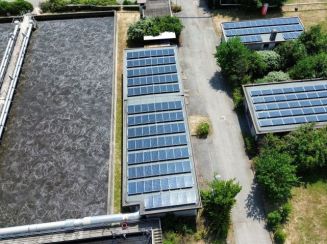
From today, the Rimini’ sea will be even more blue. The sewage redevelopment works for this Romagna city has taken an important step forwards. This morning, the ribbons were cut at the opening ceremony for the new Santa Giustina purification plant, which is now fully operational. The plant has doubled in size and capacity: the project is the most technologically important part of the Bathing Protection Plan executed by the Municipality of Rimini, Hera, Romagna Acque and Amir. The plan will cut discharges into the sea in half by 2016 and eliminate them entirely in 2020.
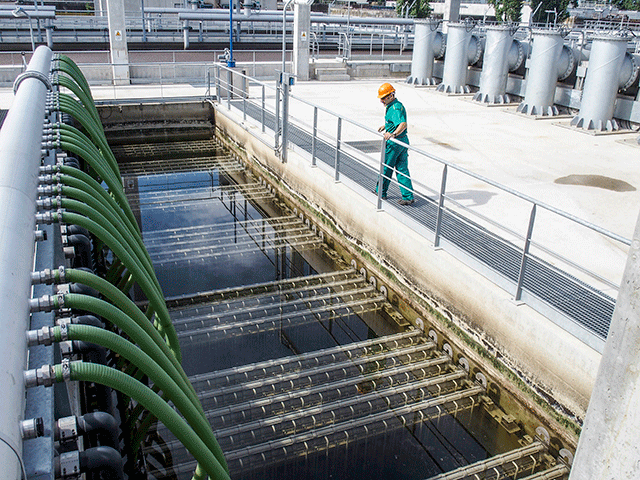
Thanks to the works in recent years, the new Rimini purification plant will be the biggest in Europe using membrane technology ultrafiltration: it is a highly innovative, cutting-edge development which, courtesy of investments made in 2011, of almost €30 million (more than €40 if you also count the works for building the Dorsale Nord), can now serve the equivalent of 560,000 inhabitants during the summer season and 370,000 the rest of the year. The works concentrated on the construction of a new membrane technology ultrafiltration purification line, with a storage tank with a capacity of approximately 26,000 cubic metres (the equivalent of almost 10 Olympic-size swimming pools) and a final disinfection system, which eliminates bacteria and viruses.
Over the next 5 years, the plant will treat all the wastewater of the area, which includes the Municipalities of Rimini, Coriano, Santarcangelo, Verucchio, Poggio Torriana, Bellaria Igea Marina, San Leo, Borghi (of the province of Forlì-Cesena) and the wastewater of the Republic of San Marino, centrally. The doubling in size of the purification plant received the green light from Arpa which had already conducted many checks on the purified water.
The old plant will remain operational and will continue to serve 220,000 inhabitants, plus the 340,000 served by the new purification plant (giving the total figure of theequivalent of 560,000 inhabitants): this figure corresponds to the requirements of Rimini when the tourists in the summer season are included. In addition to all of this, there will be odour control, improved management flexibility and reliability compared with the old system and natural, sustainable filters will be used.
The purification route of the new system has been organised in the following way: the pre-treatments to separate sand and oil will take place in an initial sedimentation compartment, while in the second stage the wastewater will be “cleaned” by the actual bacteria present in the water to be purified. This process is known as the biological cycle: a process in which the main protagonists are living organisms which, literally, feed on the pollutant substances in the wastewaters, with the residues being easy to isolate. The ultrafiltration membranes are activated in the third stage: they operate as tiny “straws” (0.04 microns in diameter, in other words millionths of a millimetre) and are capable of intercepting microscopic particles, for example viruses, bacteria or flakes of mud. The water that comes out is already clean, but before being returned to the rivers it goes through the last purification or final disinfection to entirely remove any last micro-organisms that might be present.
In this way, the purification plant complies with the latest restrictive legal limits when discharging the water into the Marecchia River. As well as this, Hera has installed efficient remote control and remote management systems, paying special attention to the mechanisms that enable the protection of the environment in emergency conditions. The centralised control system is equipped with two CPUs (central processing units), each one providing back up for the other one, which will allow all the wastewater collection networks for the Bellaria – Igea Marina area and the northern part of Rimini to be controlled from a single place. This allows prompt intervention if there is a breakdown or emergency situation.

FOTOALBUM
NEWS