How Are End-of-Life Solar Panels Recycled? Camec's Answer to the Problem
From WEEE collection to recoverable fractions: the complete journey of a decommissioned solar module and the role of dedicated recycling plants.
A solar panel generates energy for 25–30 years. Then it reaches end of life: the module loses efficiency, gets replaced, and becomes waste that needs to be managed. As the wave of installations from the 2000s approaches decommissioning, the incoming volumes are enormous, and solar panel recycling is shifting from a niche topic to an industrial necessity. The good news is that a decommissioned module isn't ordinary waste: it's a concentrate of glass, aluminum, silicon, and copper, and dedicated recycling lines — like those designed and built by CAMEC — recover up to 99% of its weight.
How many solar panels will reach end of life?
International projections estimate around 78 million tonnes of end-of-life solar modules worldwide by 2050 (source: IRENA). For Italy, one of the European markets with the oldest installed base, industry estimates put the figure at around 4.5 million tonnes by the same date (source: research from the University of Catania and Palermo). These are numbers that no supply chain can absorb without dedicated plants. Furthermore, landfill disposal is prohibited and would waste materials that have real market value.
What does the regulation say about decommissioned solar panels?
Solar panels are classified as WEEE (Waste Electrical and Electronic Equipment) under European Directive 2012/19/EU, transposed into Italian law by Legislative Decree 49/2014. In summary, the framework requires:
- extended producer responsibility: whoever places modules on the market must guarantee their collection and treatment at end of life, either directly or through collective schemes;
- an obligation for separate collection and delivery for recovery at plants authorized to treat WEEE;
- minimum targets for material recovery and recycling, which require technologies capable of separating fractions at high purity levels.
For plant operators and consortia, the question is therefore no longer whether to treat solar panels, but which technology to use to do so efficiently and in compliance with regulations.
Which solar panels can be recycled?
A standard solar module weighs about 20 kg and is made up, on average, of glass (73%), plastic (12%), aluminum (10%), silicon (3%), and other metals (2%). Dedicated recycling lines handle the types that cover almost the entire installed base:
- monocrystalline and polycrystalline silicon modules with a glass-plus-backsheet structure, the most common configuration;
- glass-glass modules, including bifacial solar panels: removing the second layer of glass requires a dedicated module on the line, developed by CAMEC in partnership with Ecoprogetti.
Thin-film or amorphous silicon modules and concentrated photovoltaics fall outside the scope of these lines, as they require different processes.
How does a solar panel recycling plant work?
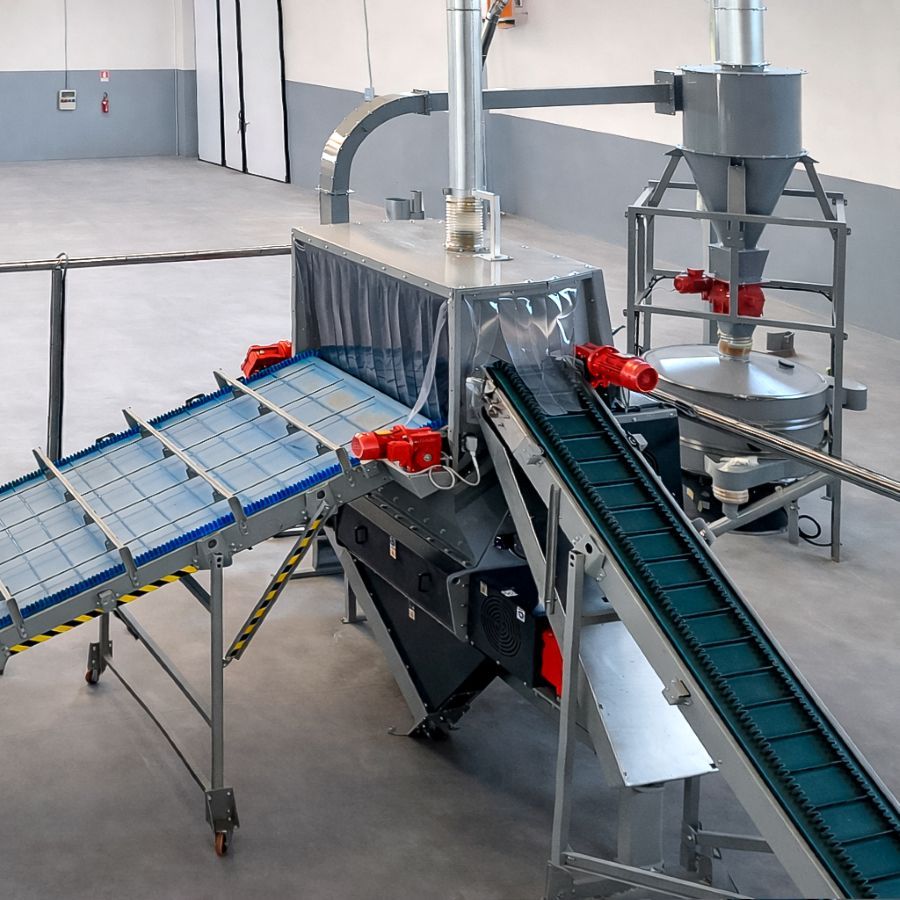
The reference process is entirely mechanical: there is no combustion, no use of chemical agents, and no process emissions.
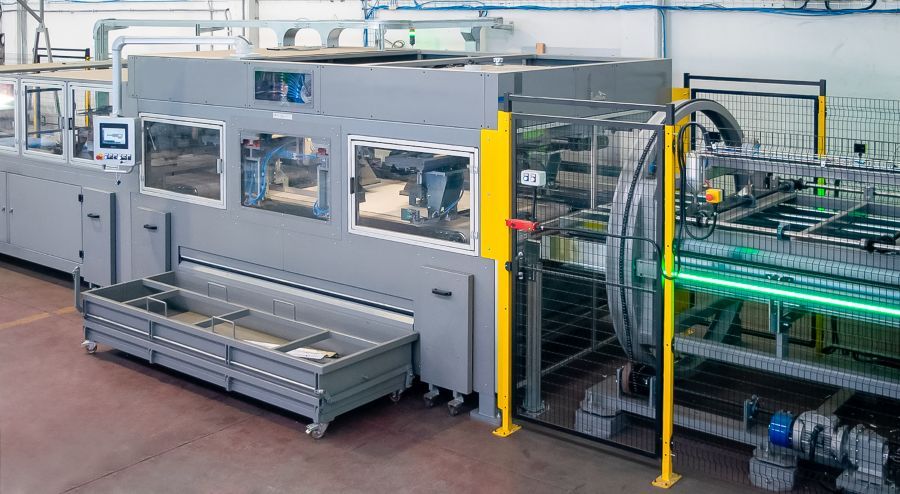
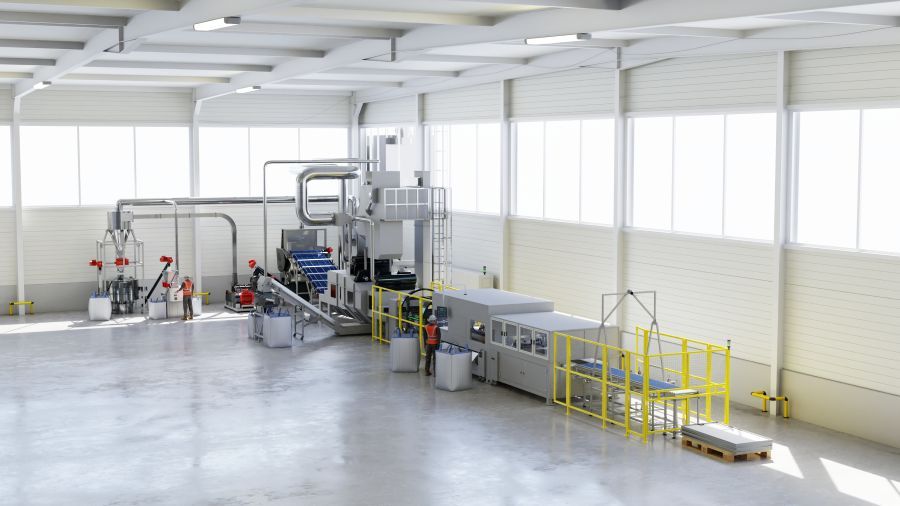
The CAMEC line processes the module in ten stages:
1 Solar panel optical system: recognizes the module's dimensions and orientation.
2 Removal of the junction box (J-box).
3 Removal of the aluminum frame.
4 Module flipping, to expose it for the next stage.
5 Glass removal: the patented delaminator separates 100% of the glass from the laminate.
6 Glass screening into three particle-size fractions (fine, medium, coarse).
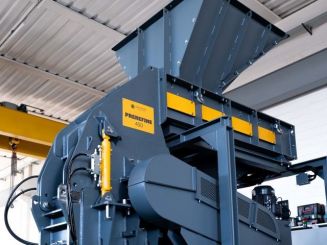
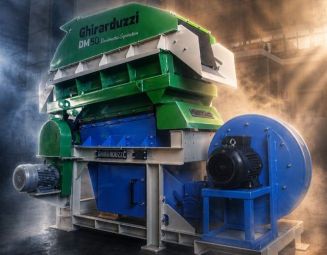
7 Laminate shredding with a GRR280 single-rotor granulator, followed by a second pass through a turbine.
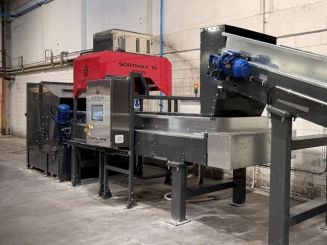
8 Fraction separation on a density separation table.
9 Collection of output fractions.
10 Process air filtration.
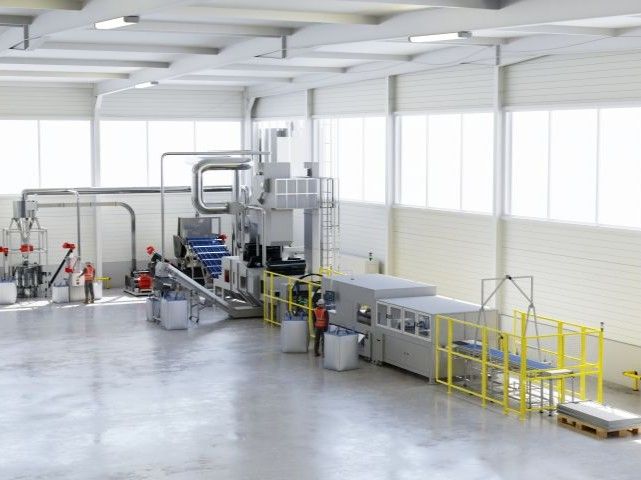
The line is available in two configurations: 60 panels/hour (about 1.5 t/h, 130 kW, 500 m²) and 120 panels/hour (about 3 t/h, 160 kW, 600 m²), both operable by two people. Options include dedicated recovery of J-boxes and aluminum profiles, and automated loading.
Learn more about Camec dedicated products here
A useful clarification for understanding the supply chain: CAMEC does not carry out recycling activities itself. It designs and builds, on a turnkey basis, the plants that recovery operators and managers use to recycle solar panels.
What materials are recovered from a solar panel?
Overall, the line recovers up to 99% of the module's weight. The highest-value fractions are also extracted from the laminates: the silver from the contacts and the copper from the interconnections.
Frequently asked questions
How long does a solar panel last before reaching end of life?
The typical service life is 25–30 years. End of life can come earlier due to damage, hail, manufacturing defects, or plant repowering — that is, early replacement with more efficient modules.
Can bifacial solar panels be recycled?
Yes. Glass-glass modules require glass removal on both sides: on CAMEC lines this is handled by a dedicated module with a patented delaminator. This topic is covered in more depth in the article on end-of-life bifacial modules [insert link once the article is written and published].
Who recycles solar panels in Italy?
Treatment is carried out by operators and consortia authorized for WEEE recovery, who work with dedicated plants. CAMEC is the Italian manufacturer of these plants: it supplies turnkey lines, fixed or mobile, to recycling operators.
Is it economically worthwhile to recycle solar panels?
Yes, if the technology guarantees high purity levels: the recovered fractions have market value, and for a CAMEC line the estimated payback period is 1–2 years.
Want to evaluate a solar panel recycling plant?
CAMEC's technical team is available to help identify the configuration best suited to your volumes and flows. Contact CAMEC team for personalized technical advice.

FOTOALBUM
NEWS